

logo

The Foundation of Clarity: Defining Your Asset Hierarchy

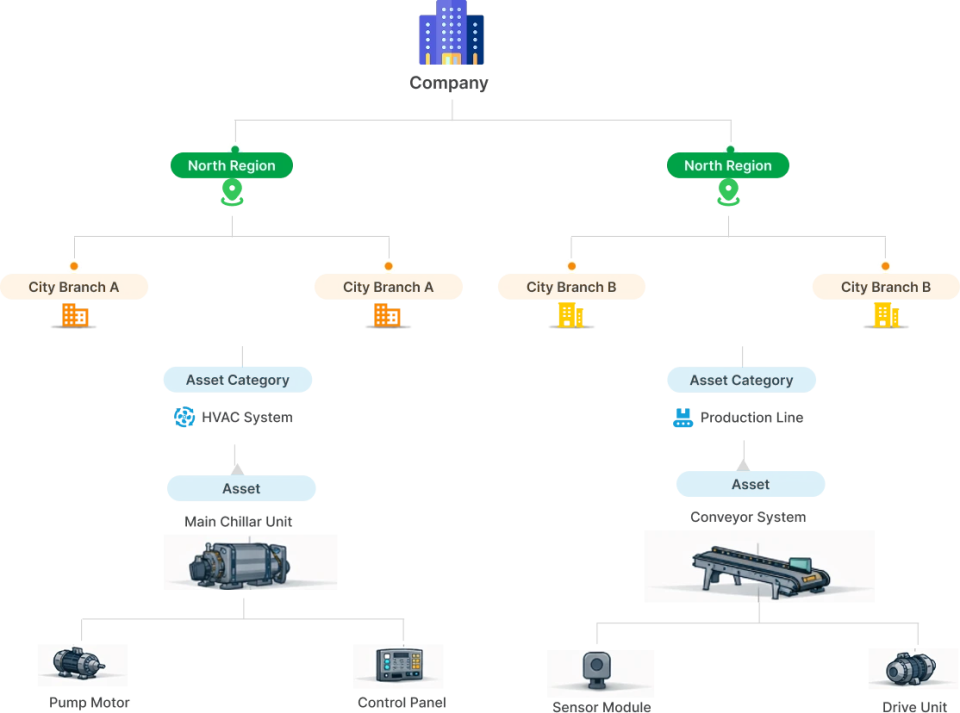
To put it simply, asset hierarchy defines a structured framework that organizes assets into parent-child relationships. It mirrors real-world operations – making tracking, servicing, and reporting more intuitive.  
Asset Hierarchy

How Asset Hierarchy Works in ServiceStation? 

Asset hierarchy in ServiceStation is designed to reflect how your assets actually operate in the real world. It provides a structured foundation that connects assets, locations, and components into a single, manageable system.

STEP 01
Define Hierarchy Levels

Configure hierarchy levels that reflect your real-world operations, from regions to locations, asset categories, assets, and components.

STEP 02
Assign Assets & Sub-Assets

Map individual assets and their components to the right locations for accurate tracking and ownership.

STEP 03
Apply Warranties, SLAs & Service Rules

Link contracts, warranty terms, and SLA rules at any hierarchy level—asset, component, or location.

STEP 04
Track Service History at Every Level 

View maintenance, repairs, and performance history across regions, sites, assets, or individual components.

STEP 05
Generate Hierarchy-Aware Reports 

Analyze costs, downtime, and performance with reports that respect your asset structure. 

Scaling with Precision: Essential Asset Hierarchy Use Cases

When it comes to mirroring real operational needs, nothing beats a staunch asset hierarchy system. These use cases demonstrate how structured asset relationships help teams manage complexity, thus enhancing service accuracy.

Multi-Location Service Networks

Who it's for: Enterprises, franchises, service partners

Track and manage assets across cities, regions, franchises, or partner networks using a single, standardized hierarchy—without losing local visibility.

Key Outcome: Consistent asset control across distributed operations.

Large Equipment & Machinery

Who it's for: Manufacturing, facilities, infrastructure teams

Manage complex assets by breaking them down into sub-assets and components, each with its own service history, warranty, and lifecycle.

Key Outcome: Component-level maintenance and faster issue resolution.

Warranty & AMC Tracking

Who it's for: Operations, finance, service teams

Apply warranty terms and AMC contracts at the asset, component, or location level, and ensure the right rules are enforced during every service job.

Key Outcome: Accurate coverage tracking and fewer billing disputes.

Preventive Maintenance Planning

Who it's for: Asset managers, operations heads

Schedule preventive maintenance based on asset criticality, usage, or hierarchy level to reduce breakdowns and extend asset life.

Key Outcome: Reduced downtime and predictable maintenance cycles.

Hierarchy-Aware Reporting for Asset Performance

Access accurate, hierarchy-driven insights that reflect how your assets are actually structured.

Asset Uptime by Region

Monitor reliability and availability across regions, zones, or franchises.

Maintenance Cost by Location

Track service spends at branch, site, or facility level to control costs.

Failure Trends by Asset Category

Identify recurring issues across asset types to improve planning and standardization.

Component-Level Repair Frequency

Detect high-failure components early to reduce repeat breakdowns and downtime.

Layer Your Assets. Cut Complexity. 

ServiceStation lets you structure assets in a way that matches how your business actually works. Group assets by location, category, or any level that makes sense for your operations. 

Request a Demo

What You Can Do with a Structured Asset Hierarchy?

When assets are structured logically, everyday operations become faster and more reliable. A well-defined asset hierarchy helps teams reduce complexity, improve service efficiency, and make better decisions at every level.

Asset Hierarchy
Faster Asset Identification

Quickly locate assets across regions, sites, and categories without manual searching.

Accurate Service Assignment

Automatically route jobs to the right teams based on asset type, location, and priority.

Component-Level Maintenance Tracking

Track service history, failures, and replacements at the component level for greater precision.

Location-Wise Performance Analysis

Compare uptime, costs, and reliability across branches, facilities, or regions.

Reduced Asset Duplication

Maintain a single source of truth for assets to prevent duplication and data inconsistencies.

Support Expert

Turn Asset Complexity into Operational Clarity 

Replace fragmented asset data with a structured hierarchy built for scalable operations. 

Explore Asset Management